
You Will Be Found
Lessons from Dear Evan Hansen on Despair and Deception

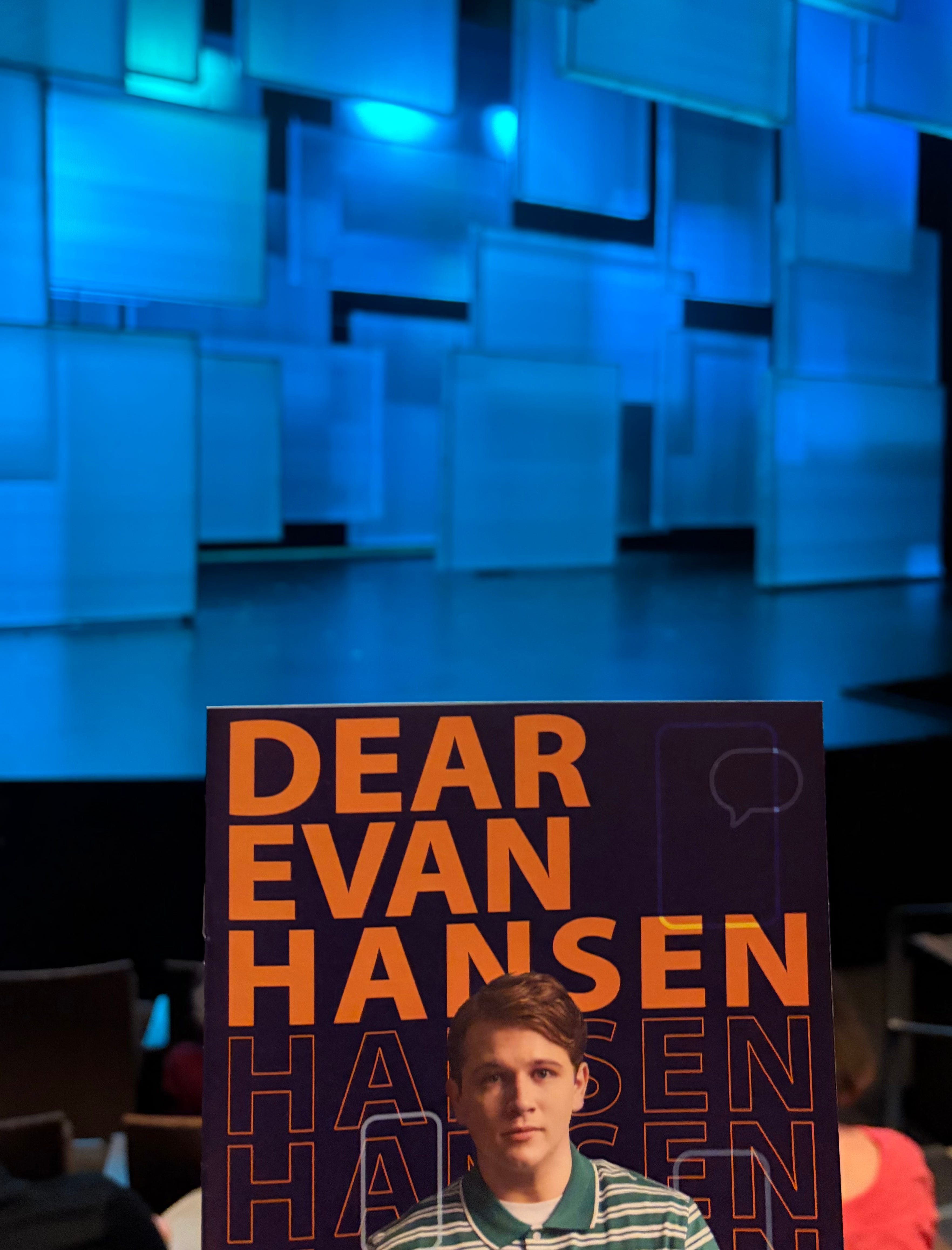
This weekend, my husband and I attended a community theater performance of Dear Evan Hansen. The story follows a socially-anxious teenager who, in a moment of panic and longing, tells a lie that spirals into an entire alternate reality—one that briefly gives him the belonging he craves, but ultimately collapses under its own weight. The initial lie follows the suicide of a classmate, and the musical follows the family’s grief, as well as the tangled web of lies that quickly spreads through social media.
Here at Holy Family, the musical hit home in a deeply personal way. Our Bible study has been praying for the family of a high school student—we’ll call him Beto—who recently threatened suicide. Beto’s family rallied to support him, and we, in turn, have been discerning how best to be of support to him and his family. As Dear Evan Hansen reminds us, such actions do not happen in isolation. They ripple outward, touching parents, siblings, classmates, entire communities.
So let’s talk about it—honestly, pastorally, and with the extraordinary courage this moment demands.
A Quiet Crisis: When Death Feels Like the Better Option
In a seminary course nearly 30 years ago, I learned something that has stayed with me: People consider suicide when they lose hope—when the thought of death begins to seem preferable to the pain they are experiencing. That thought rushes back every time I assist a family dealing with suicide—or the threat of suicide—and I’m reminded of the harsh judgment that the Roman Catholic Church passed for centuries on those have taken their lives, suggesting that they, like Judas Iscariot, succumbed to the mortal sin of despair, and sadly denying them Christian burial beginning in the sixth century.
Fortunately, our stance has evolved, and contemporary moral theology often focuses more on mental health factors and God’s mercy.
Consider these facts:
Suicide remains a leading causes of death among young people in the U.S.
Rates are especially high among adolescents and young adults.
LGBTQIA+ youth, in particular, face significantly elevated risk.
Millions report serious thoughts of suicide each year, and many engage in self-harm as a coping mechanism.
Behind every statistic is a story. A family. A “Beto.”
My own anthropology has long been quite simple in this respect: As human beings, we always choose what appears to us to be best option in any given situation.
Adam and Eve ate the forbidden fruit because knowledge seemed better than ignorance (Gen. 3).
A child lies about a broken lamp because avoiding punishment seems a better option than telling the truth.
Hurting individuals contemplate death because it feels like relief from whatever they’re currently suffering.
This does not make the choice good. It makes it human.
Scripture meets us here with unflinching honesty:
Elijah, exhausted, asked God to let him die (1Kgs. 19:4)
The psalmist cried, “Why are you cast down, O my soul?” (Ps. 42:5)
Even Jesus, in Gethsemane, wrestled with anguish, asking that the cup of suffering be taken away from him (Mt. 26:38-39)
Despair is not new. But neither is God’s response.
“Anybody Have a Map?”: Parenting in the Unknown
The first song in Dear Evan Hansen—“Anybody Have a Map?”—captures something every parent knows, but rarely admits:
“I’m flying blind. And I’m making this up as I go.”
As the second of four sons, I watched my parents navigate challenges they never anticipated. They did not always get it right. None of us do. And now I see younger generations of parents trying their best to get it right.
Parenting is an act of faith.
Scripture affirms this uncertainty:
“Train up your children in the ways they should go…” (Prov. 22:6)—and yet there are no guarantees.
“Children are like arrows in the quiver of the warrior” (Ps. 127:4-5): Sometimes they fly straight when we let go, and sometimes the “winds” of this world carry them in other directions!
The parents of a prodigal child, likely with great anguish, let go (Lk. 15).
Even Mary and Joseph lost track of the ‘tween Jesus for three days (Lk. 2:46)!
Yes, even Mary and Joseph experienced their moments of “flying blind.”
Hence, the question: “Anybody Have a Map?” The song invites not perfection, but compassion—for parents, for children, for ourselves.
The Lies We Tell (and Why We Tell Them)
At the heart of Dear Evan Hansen is a lie.
Evan does not set out to deceive. He longs to belong. And when an opportunity presents itself—even if built on tragedy—he steps into it.
Why?
Because the lie offers Evan something the truth has not yet given him: connection.
We see this pattern everywhere:
In The Greatest Showman, identity is curated to win acceptance.
In Inside Out, emotions are suppressed to maintain appearances.
In Euphoria, pain is masked through performance.
In Mean Girls, narratives are constructed to secure belonging.
In The Matrix, illusion becomes preferable to reality.
And yes, we see it in our national life.
When individuals—or leaders—construct alternate realities, repeat outright lies, or reshape truth to maintain control, we are witnessing the same human impulse: the desire to survive, to belong, to win.
Scripture again clearly speaks:
“The truth will set you free” (Jn. 8:32)
“Speak the truth in love” (Eph. 4:15)
“You shall not bear false witness” (Ex. 20:16)
Truth is not merely moral. It is liberating.
“You Will Be Found”: The Gospel According to Belonging
If Dear Evan Hansen exposes despair and deception, it also offers extraordinary hope.
“You Will Be Found,” the song that concludes the first act, has become an anthem for a reason:
“Even when the dark comes crashing through…
when you need a friend to carry you…
you will be found.”
That is Gospel.
Jesus sought the lost sheep (Lk. 15:4)
He ate with outcasts (Mk. 2:16)
He told a thief, “Today you will be with me in paradise” (Lk. 23:43)
The early Church shared everything, so no one was in need (Acts 4:34)
Paul tells us that nothing can separate us from God’s love (Rom. 8:38-39)
Belonging is not a bonus feature of Christianity. It is its core.
In a world where so many feel unseen, unheard, unloved, the Church is called to embody extraordinary presence!
To say—not just with words, but with lives: You will be found.
When a Musical Becomes Reality
It would be easy to keep this reflection safely within the theater.
But we cannot.
Because Dear Evan Hansen is playing out in real time.
We are living in a moment when narratives are constructed, amplified and believed—even when they diverge from reality. When leaders engage in rhetoric that distorts truth, targets opponents, or escalates conflict, the stakes are no longer theatrical.
They are global.
During his first four years in office, our U.S. president told a recorded 30,573 lies and misleading statements—including his hardly-forgivable championing of horse dewormer and bleach as COVID treatments and his anti-vaccine rhetoric, which contributed to 300,000+ preventable deaths among unvaccinated adults in 18 months. More recently, his social media rant against Pope Leo XIV on Sunday, followed by his self-aggrandizing portrayal as Jesus amid escalating international tensions, raise serious moral questions about truth, power and responsibility.
This is not about partisanship. It is about reality.
Because when lies take root—whether in a teenager’s heart or a nation’s leadership—the consequences ripple outward.
Just like in the musical.
Extraordinary Courage: What We Are Called to Do
In this very unordinary U.S. moment, what does faithful response look like?
Tell the truth, even when it is uncomfortable.
Deeply listen to those who are struggling, especially young people.
Take seriously mental health, removing stigma and offering support.
Create communities of belonging where no one feels invisible.
Challenge false narratives with compassion and clarity.
Model vulnerability, acknowledging that we, too, are “making it up as we go.”
Choose life, in all its complexity and beauty.
Sitting in the Dark Together
As the lights came up at the end of Dear Evan Hansen, I found myself thinking about Beto. About his parents. About all the families quietly carrying burdens we rarely see.
And I thought about that line again:
“Anybody have a map?”
No, we don’t.
But we do have each other.
We do have faith.
And we do have a God who enters our darkness and refuses to leave us there.
In this Easter season, we proclaim that death does not have the final word. Not on a stage. Not in a teenager’s life. Not in our world.
And so we sit in the dark—together—holding onto the extraordinary hope that somehow, some way…
We will be found.
Questions for Prayer & Reflection
When have I experienced moments of despair or disconnection?
How do I respond when others construct narratives that are not true?
In what ways can I create spaces of belonging for young people?
Where is God inviting me to speak truth with greater courage?
How do I accompany those who are struggling with mental health challenges?
What does extraordinary hope look like in my life today?
Let Us Pray
God of light in the darkness,
You see us when we feel invisible,
and You love us when we feel unworthy.
Be near to all who are struggling today—
especially young people who feel alone or overwhelmed.
Give us the courage to tell the truth,
the compassion to listen without judgment,
and the wisdom to walk with others in their pain.
Help us to build communities
where no one is forgotten,
no one is dismissed,
and everyone knows they are loved.
And when the darkness feels too heavy,
remind us—again and again—
that in you, we will be found.
Amen.
We thank you for your prayerful consideration of a personally-meaningful gift this Easter season to support progressive Catholic voices. According to the Pew Research Center, 47% of Americans have a personal connection to Catholicism, and 13% of U.S. adults self-identify as former Catholics. Help us reach them with real good news!
Thank you for “liking,” restacking or sharing these words with those who might need them now!
Reach out to us! editor@extraordinarycatholics.faith | P.O. Box 2386, Austin, Texas 78768
So well said Fr Jayme!!!!! Thanks for an insightful read.