
“Who Am I?”
Erik Erikson, Identity Formation, and the Extraordinary Work of Becoming Human

Long before I ever studied leadership theory, theology, organizational ethics, or pastoral ministry, a simple undergraduate psychology course first opened my eyes to one of life’s most profound and enduring questions: Who am I? Today, as we remember the developmental psychologist Erik Erikson, perhaps we are invited not merely to analyze personality theory, but to reflect upon the extraordinary forces—family, culture, religion, politics, trauma, love, community and grace—that slowly shape us into the people we become!
As one who grew up in rural Ohio before eventually making his way “from the cornfields of Ohio to the corn tortillas of Texas,” I still vividly remember my fascination with my first psychology course as an undergraduate at Saint Louis University.
Honestly, it felt like discovering an entirely new lens through which to understand humanity.
Why do people behave the way they do?
Why do families so profoundly shape us?
Why do some people flourish, while others struggle?
Why do insecurity, shame, confidence, trust, fear, compassion, prejudice, resilience and love emerge so differently among human beings?
And perhaps most importantly:
Who, really, am I?
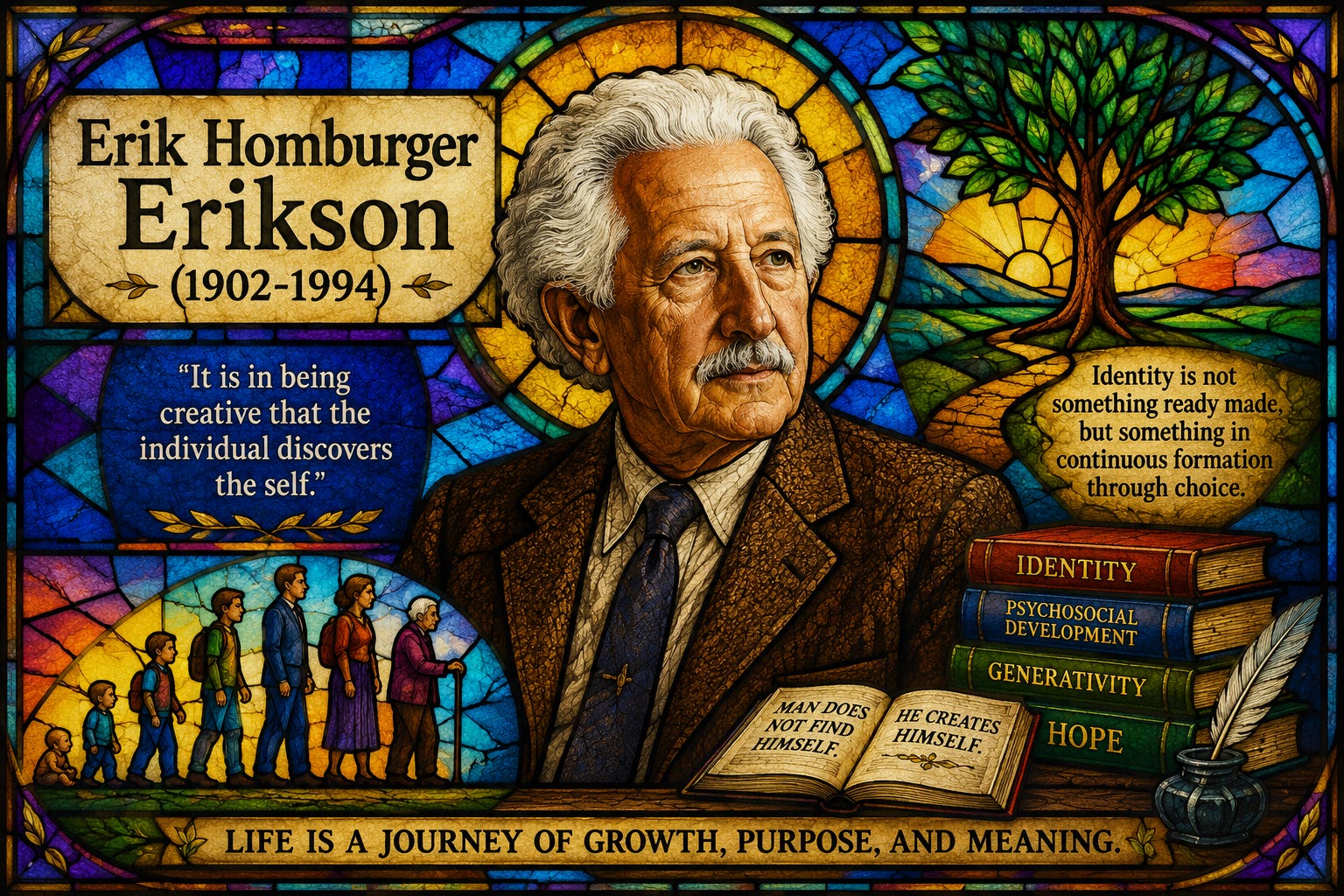
During that course, I first encountered the work of Erik Erikson (1902-1994), whom we remember today. Erikson became famous for his theory of psychosocial development and for popularizing the phrase “identity crisis.” Looking back now as someone with decades more life experience, education, pastoral ministry, leadership, and hard-earned self-awareness, his framework admittedly strikes me as somewhat overly tidy, linear, Western and reductionistic.
Still, 35 years ago, it provided me extraordinary fodder for reflection.
And if I am honest, perhaps Erikson’s stage of “Generativity vs. Stagnation” (ages 40-65) deeply resonates with where I find myself today: teaching, preaching, publishing books, mentoring younger leaders, publicly advocating, and trying in my own imperfect ways to leave this world slightly more compassionate, just, inclusive and thoughtful for future generations.
Perhaps many of us eventually arrive there.
Or at least hope to.
Erikson’s Eight Stages: A Map of Human Becoming
Erikson proposed that human beings move through eight developmental stages across the lifespan, each involving a central psychological tension or crisis requiring resolution.
Trust vs. Mistrust, in infancy.
Autonomy vs. Shame, in early childhood.
Initiative vs. Guilt, around pre-school.
Industry vs. Inferiority, during early school years.
Identity vs. Role Confusion, in adolescence.
Intimacy vs. Isolation, in young adulthood.
Generativity vs. Stagnation, in midlife.
Integrity vs. Despair, in old age.
The theory suggested that how we navigate earlier stages influences later development. A child who experiences consistent love and security develops basic trust. Adolescents explore identity. Adults seek intimacy, meaning, creativity, contribution, and ultimately peace regarding the lives they have lived.
There is something deeply compelling about this framework because we intuitively recognize truth within it.
Many adults still carry childhood mistrust.
Many adolescents still wrestle with identity confusion.
Many older adults painfully wrestle with regret, isolation or despair.
And perhaps every human being, at every age, continues asking some version of the same question:
Who am I becoming?
Scripture itself often reflects developmental journeys remarkably similar to Erikson’s concerns. Moses wrestled with inadequacy. Jeremiah protested that he was too young. Peter repeatedly failed before maturing into leadership. Thomas doubted. Paul radically reconstructed his identity after his conversion on the road to Damascus. A prodigal child moved from rebellion toward reconciliation and self-understanding.
Even Jesus “grew in wisdom and age and favor before God and others” (Lk. 2:52).
Growth matters.
Development matters.
Life and growth are dynamic, and human beings, at their best, are far from static!
More Framework Than Science
And yet, as much as I appreciate Erikson’s contributions, I also remain appropriately skeptical.
His theory lacks the empirical precision that modern psychology often demands. The mechanisms driving stage “resolution” remain vague. The stages themselves can feel rigid and artificially sequential. Human growth rarely unfolds neatly. Life is messy. Trauma interrupts development. Healing sometimes happens late. Some people repeatedly revisit identity crises across decades.
Furthermore, Erikson’s framework reflects strong cultural and gender biases. Much of his research centered Western, European and North American populations, often prioritizing traditionally male developmental assumptions about career, achievement and autonomy.
Women’s experiences often fit awkwardly into such models. LGBTQIA+ experiences certainly received little consideration in Erikson’s era.
As a gay man raised in conservative Catholic contexts during the 1970s and 1980s, I know firsthand that identity formation rarely follows clean developmental timelines. For many LGBTQIA+ persons, adolescence and young adulthood become minefields of secrecy, shame, fear, survival and delayed self-understanding.
Some of us spend years trying to become versions of ourselves that family, church or society might accept.
Some of us come out not only to others, but eventually to ourselves.
And that process often unfolds far beyond adolescence.
Thus, perhaps Erikson’s model works best not as hard science, but as a descriptive developmental framework—a useful map, rather than an infallible blueprint.
Families, Culture and the Making of Personality
What still fascinates me about psychology is how profoundly our environments shape us.
I think about my own upbringing: my father training as a draftsman then working factory jobs, my mother sacrificing her career in cosmetology to raise four sons, the realities of rural Ohio, family bouts with scoliosis, the quiet expectations of masculinity within Midwestern Catholic culture.
All of that shaped me.
Being the second of four boys shaped me.
Being academically-driven shaped me.
Being encouraged to take up various musical instruments shaped me.
Joining the Conventual Franciscan Friars at eighteen shaped me.
Studying philosophy and theology shaped me.
Coming out as gay shaped me.
Being greatly empowered by my ordaining prelate shaped me.
Serving immigrant communities shaped me.
Public conflict with conservative hierarchs shaped me.
Falling in love shaped me.
Even now, with more than a half-century of life experience, I continue evolving.
Perhaps we all do.
That insight feels especially important during this Easter season when Catholics weekly hear pericopes from the Acts of the Apostles. The early Christian community itself underwent identity development. The disciples slowly evolved from frightened followers hiding behind locked doors, into courageous public witnesses.
Pentecost transformed them. Experience transformed them. Community transformed them.
The resurrection narratives themselves remind us that human beings continually grow into deeper awareness, deeper courage and deeper love!
Spiritual Development Evolves, Too
Years after first studying Erikson, during my graduate theological studies, I encountered James W. Fowler and his theory of the stages of faith development.
Fowler similarly argued that spirituality developmentally evolves over time. Childhood faith tends toward literalism and external authority. Adolescent and young adult faith often becomes conformist. Mature spirituality ideally moves toward complexity, paradox, justice and universal compassion.
Whether one fully accepts such stage theories or not, they illuminate something important: Faith itself develops!
Many adults still operate spiritually with the rigid certainties of childhood religion. Others eventually embrace deeper nuance, humility, ambiguity and compassion.
One sees similar themes in the work of Richard Rohr, who speaks about moving beyond ego-driven religion, toward deeper contemplative consciousness and radical compassion.
Honestly, I suspect many believers arrive where they are not because they abandoned faith, but because they allowed their faith to mature.
The Apostle Paul himself writes: “When I was a child, I used to talk as a child… think as a child… reason as a child. When I became an adult, I put aside childish things” (1Cor. 13:11).
That sounds remarkably developmental!
Psychology in the Age of Trump
And then there is our present and very unordinary U.S. sociopolitical moment—which has provided endless material for psychologists, psychiatrists, sociologists, and anyone trying to understand human behavior.
It is difficult to watch contemporary American politics without recognizing powerful psychological dynamics at work: narcissism, fear, tribalism, projection, insecurity, grievance, authoritarianism, identity anxiety, and cult-like group attachment.
Dr. Mary L. Trump, the president’s niece, has written extensively about family systems, emotional deprivation, and personality development within the Trump family environment. Her work reminds us that personality does not emerge in a vacuum.
Neither does political behavior.
Why do some people cling so fiercely to authoritarian leaders? Why do obviously false claims persist? Why does cruelty sometimes become attractive? Why do followers tolerate behaviors in some individuals that they would condemn in others?
Psychologists point toward fear, social identity, perceived threats, belonging needs, propaganda, unresolved grievances, and the human longing for certainty amid chaos.
Erikson would likely recognize identity anxiety everywhere in this unordinary U.S. moment.
Perhaps many people today feel psychologically untethered. Economic shifts, demographic changes, declining institutional trust, technological overload, social fragmentation, religious decline, and cultural polarization all contribute to profound collective instability.
And frightened people often seek simplistic answers, rigid identities, charismatic authority figures, and tribal belonging.
One sees these dynamics throughout pop culture as well: Inside Out beautifully explores emotional development. Good Will Hunting portrays trauma and identity formation. Ted Lasso reflects emotional healing and vulnerability. Moonlight explores sexuality, masculinity and identity. The Breakfast Club reminds us how adolescents struggle beneath labels and stereotypes. Even Michael Jackson’s “Man in the Mirror” captures the lifelong challenge of self-examination and transformation.
Human beings ache to understand themselves!
Extraordinary Calls for People of Faith
Support children and adolescents with extraordinary compassion, recognizing how formative early experiences can become.
Advocate for expanded access to mental healthcare, counseling, and trauma-informed support systems.
Create faith communities where LGBTQIA+ youth, questioning adolescents, and marginalized persons can safely explore identity without fear or shame.
Encourage emotional literacy among boys and men raised within cultures discouraging vulnerability.
Resist simplistic judgments about others’ behavior, and instead cultivate deeper curiosity about human experience and development.
Promote education, critical thinking, and psychological awareness as tools for healthier democracy and healthier relationships.
Recognize that spiritual growth often requires questioning, evolution, and periods of uncertainty.
Build communities rooted not in fear or rigid conformity, but in belonging, compassion, accountability and healing.
Support parents, teachers, counselors and mentors who profoundly shape the lives of younger generations.
Embody extraordinary patience with ourselves and others as we continue becoming who we are.
Returning to the Psychology Classroom
As I think back to that young undergraduate sitting in a psychology classroom decades ago, I smile a bit.
At the time, I could not possibly have imagined all the identities I would eventually inhabit: friar, deacon, priest, educator, administrator, elected official, executive director, author, activist, husband, consultant, runner, traveler, language learner, spiritual seeker.
Nor could I have imagined the identities I would eventually shed.
Perhaps that is part of what Erikson understood best.
Human beings are always… becoming!
And maybe resurrection itself reflects that truth.
During Easter season, Christians proclaim not merely that Jesus rose from the dead long ago, but that transformation remains possible now. Fear can become courage. Isolation can become community. Shame can become dignity. Despair can become hope.
None of us emerges fully formed.
We evolve slowly through love and loss, success and failure, belonging and rejection, trust and betrayal, faith and doubt.
And through it all, we continue asking that ancient question:
Who am I?
Or, perhaps the better question is:
Who am I still becoming?
Questions for Prayer and Reflection
Which experiences most profoundly shaped my personality and sense of identity?
Where do I still carry wounds rooted in mistrust, shame, guilt, inferiority or fear?
How has my faith evolved across different stages of life?
In what ways do family, culture, religion, politics or trauma continue influencing my behavior?
How might I better support children and adolescents during critical periods of identity formation?
What relationships or communities have most helped me grow toward authenticity and wholeness?
Where do I sense God still inviting me toward growth, healing or transformation?
Let Us Pray
God of extraordinary wisdom and compassion,
you created us not as static beings, but as people continually growing, evolving, learning and becoming.
We thank you for all who help human beings better understand themselves: psychologists, counselors, teachers, spiritual directors, mentors, parents and friends.
Heal the wounds we carry from childhood, family conflict, rejection, shame, fear and trauma.
Strengthen all who struggle with identity confusion, anxiety, isolation, depression or despair.
In a special way, protect children and adolescents navigating the difficult journey of becoming themselves in a complicated and often cruel world.
Help your church become a place of healing, rather than shame; belonging, rather than exclusion; compassion, rather than judgment.
During this Easter season, remind us that resurrection still unfolds within human hearts,
that fear can become courage,
that isolation can become intimacy,
that stagnation can become generativity,
that despair can become hope.
And as we continue asking who we are, help us slowly become people rooted in extraordinary love, extraordinary courage, extraordinary justice, and extraordinary compassion.
For we are all unfinished stories still unfolding in grace.
Amen.
We thank you for your prayerful consideration of a personally-meaningful gift this Easter season to support progressive Catholic voices. According to the Pew Research Center, 47% of Americans have a personal connection to Catholicism, and 13% of U.S. adults self-identify as former Catholics. Help us reach them with real good news!
Thank you for “liking,” restacking or sharing these words with those who might need them now!
Reach out to us! editor@extraordinarycatholics.faith | P.O. Box 2386, Austin, Texas 78768