
Chains, Courage and Conscience
Lessons from St. Hermenegild and St. Martin I in an age of power, pressure and division

Just as many children idolize their parents, I, as a boy from the cornfields of Ohio, held my father in high esteem. He overcame teenage adversity, served others, and shaped my imagination of what it meant to be a good man. For years, he volunteered as our local scoutmaster and as an emergency medical technician. He trained the altar servers at our church, and he served as Grand Knight of the Knights of Columbus.
But, considering the rural context in which he was raised, and in which he and my mother raised us, I frankly wasn’t surprised by his reply when I came out to him over 30 years ago: “We thought we raised you better than that.”
Yet, years later, in 2015, he sat in the front row at my wedding in Austin, quietly embodying a different kind of courage—one that wrestled with love, loyalty and conscience, all while knowing that he would have to fly back to Ohio and explain to family, coworkers and card-playing buddies why he traveled to Texas. My father could have responded very differently. He could have chosen not to celebrate our love. Indeed, I’ve heard numerous stories of parents who cut off communication after their children came out to them, after their own flesh-and-blood said, in the words of The Greatest Showman, “This is me.”
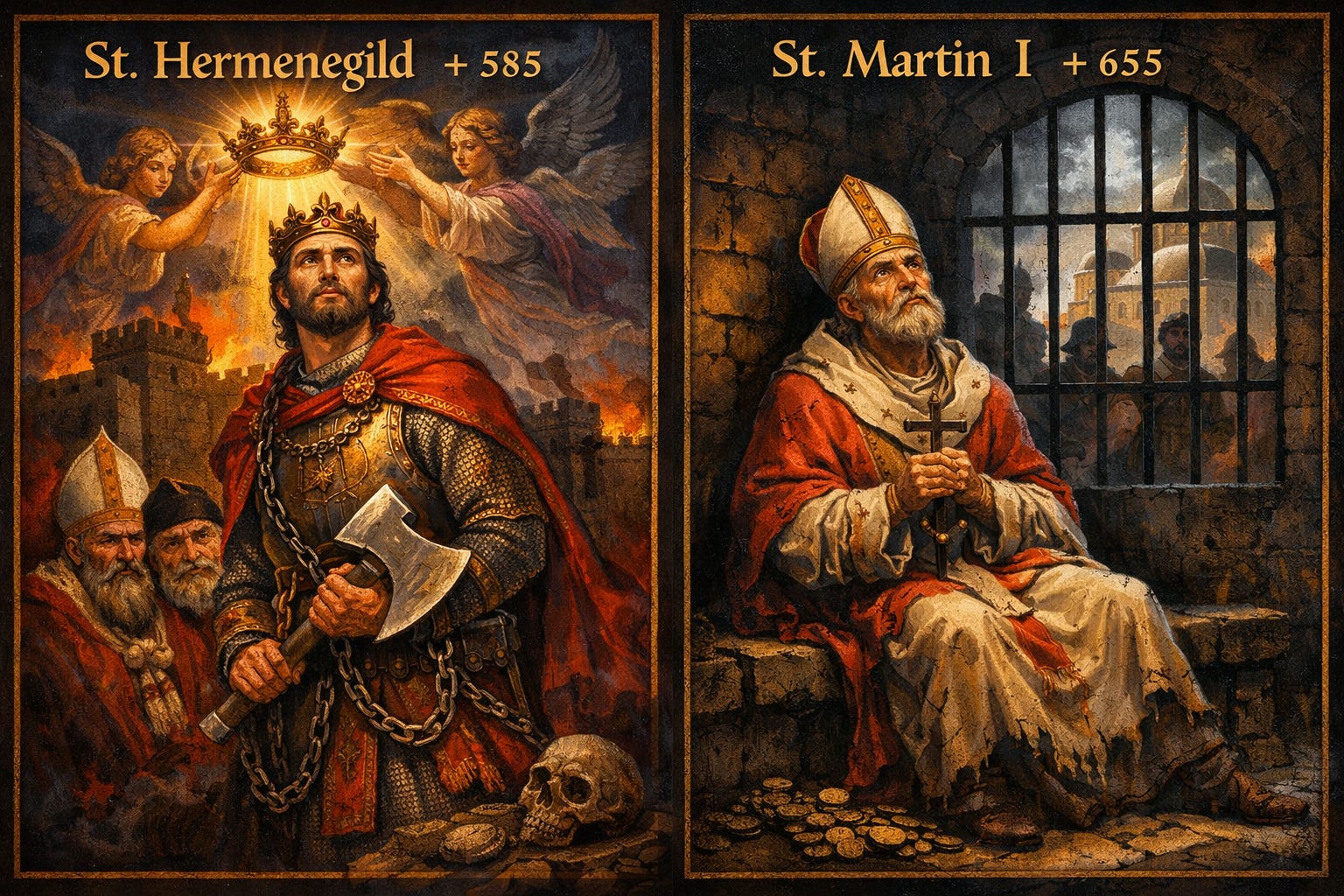
Two saints we remember today—Hermenegild and Martin I—stood at similar crossroads. Their stories reveal what happens when love, power, belief and identity collide. And they challenge us, in this unordinary U.S. moment, to ask: When pressured by family, church, or state, who do we become?
A Prince in Chains: The Cost of Conversion
In 6th-century Spain, Hermenegild (+585) was not simply a son; he was a political symbol. His father, King Leovigild, upheld Arian Christianity, a theological system that denied the full divinity of Christ. For the Visigothic elite, Arianism was more than belief; it was identity, power and control.
Then came love. Hermenegild married a Catholic princess, and through her witness—and perhaps through the quiet promptings of the Spirit—he converted to her religion. What followed was not a polite family disagreement. It was rebellion. It was betrayal.
Hermenegild’s father didn’t respond with my father’s compassion or understanding.
Instead, King Leovigild imprisoned his son. Politically-aligned bishops condemned the prince. And when Hermenegild refused to receive Communion from an Arian bishop, he sealed his fate. He died by the sword, a prince in chains, lifted in iconography above the very structures that tried to break him.
Scripture echoes here: “Whoever loves father or mother more than me is not worthy of me” (Mt. 10:37). It is a hard saying, one we would rather soften. But Hermenegild lived it.
And his witness bore fruit. His brother, Recared, later converted as well, leading an entire kingdom into Catholic unity.
Extraordinary courage rarely ends with us. It ripples!
A Pope in Prison: When the Church Turns on Its Own
If Hermenegild’s story is about family, Martin I (+655) is about the Church itself—and how easily it can fracture under pressure.
In the 7th century, the Byzantine Empire sought unity through compromise. The doctrine of monothelitism claimed that Jesus had two natures (human and divine), but only one will—since two distinct wills could cause conflict within a person. The theological middle ground was meant to appease and bridge factions in the Eastern Roman Empire: Chalcedonian orthodoxy (two wills) and monophysitism (one nature/will).
But truth is not always found in the middle, and the Third Council of Constantinople (680-681) later rejected monothelitism, choosing instead dyothelitism—that Jesus possessed two distinct wills—a divine will and a human will—that always operated in perfect harmony, with the human will acting in obedience to the divine.
Too much theology, I know. Let’s back up.
When the matter was still far from settled, Martin convened the Lateran Council (649) and condemned monothelitism. For this, Emperor Constans II ordered his arrest. Fellow Christians complied. The pope was dragged from Rome, imprisoned, humiliated, exiled.
He died not at the hands of pagans, but because of Christians!
We hear the echoes of Holy Week:
Judas betrays (Lk. 22:48).
Peter denies (Lk. 22:57).
The crowd turns (Jn. 19:15).
Pilate washes his hands (Mt. 27:24).
Human beings, under pressure, often abandon relationships and truth for safety, belonging or power.
Martin refused.
Extraordinary courage sometimes means standing alone, even within the Church you love.
Us versus Them: Why We Turn on One Another
Why do these stories feel so familiar?
Because they are not ancient history. They are human psychology.
Social scientists call it “ingroup/outgroup bias.” Scripture calls it sin.
We draw lines. We define who belongs. We protect identity at all costs. And when someone crosses those lines (like Hermenegild) or challenges the system (like Martin), we react.
We see it everywhere:
In The Hunger Games, where power demands loyalty over truth.
In Star Wars, when Anakin chooses empire over conscience.
In Ted Lasso, when belonging transforms conflict into compassion.
In The Handmaid’s Tale, where religion is weaponized to control.
In Spotlight, where truth-tellers confront institutional betrayal.
And we see it in Scripture:
Cain and Abel (Gen. 4).
Joseph sold into slavery by his brothers (Gen. 37).
The rejection of prophets (Lk. 13:34).
The division in the early Church (Acts 15).
Paul confronting Peter (Gal. 2:11).
The pattern is clear: When identity feels threatened, people often choose power over love!
Power, Fear and the Present Moment
We would be naïve to think this dynamic does not shape our own moment.
Across the United States, many have raised concerns about the use of governmental power to target perceived opponents—public officials, legal professionals, and marginalized communities. Critics have described aspects of Donald Trump’s political strategy as retributive, pointing to investigations, executive actions, and public rhetoric aimed at individuals and groups ranging from political leaders to immigrants and transgender persons.
Regardless of one’s political perspective, the deeper question for people of faith remains: What happens when power is used to divide, rather than to serve?
Jesus was clear: “You know that the rulers of the Gentiles lord it over them… It shall not be so among you” (Mt. 20:25-26).
Hermenegild faced a father who misused power.
Martin faced an emperor—and even fellow Christians—who did the same.
So do we.
Extraordinary Courage in Everyday Life
Most of us will not face execution or exile. But we will face moments—quiet, ordinary, deeply personal—where conscience demands courage.
Parents must decide whether love will override fear, prejudices and control.
Teachers must decide whether truth outweighs the pressure to have students conform.
Clergy must decide whether integrity matters more than approval.
I think again of my father, sitting in that front row seat at our wedding on the south lawn of the Texas State Capitol. He did not resolve every theological question. But he chose relationship over rejection.
That, too, is extraordinary courage.
Invitations
In light of these saints and this moment, how might we respond?
Choose conscience over conformity when systems demand silence.
Resist the temptation to dehumanize those with whom we disagree.
Speak truth with love even when it risks relationships or reputation.
Stand with the marginalized—immigrants, LGBTQIA+ persons, the poor—especially when they are targeted.
Examine our own use of power in families, workplaces, churches and communities.
Build bridges, rather than barricades, remembering that conversion often begins with relationship.
Pray for those who oppose us, as Jesus commands (Mt. 5:44).
The Courage to Stay at the Table
In the end, I return to that image: a father in the front row, a son celebrating a sacrament, a quiet act of presence that spoke louder than words.
Hermenegild refused to betray his conscience, even when it meant losing his father.
Martin I refused to compromise truth, even when it meant losing his freedom.
And yet, in my own life, I have seen another kind of courage—the courage to remain, to listen, to grow, to love beyond fear.
In this extraordinary Easter season, as we proclaim resurrection and new life, perhaps the Spirit calls us not only to heroic defiance, but also to transformative presence.
To stay at the table.
To hold tension.
To choose love.
That, too, can change the world!
Questions for Prayer & Reflection
When have I experienced tension between love and belief in my own life?
Where might I be tempted to choose belonging over truth?
How do I respond when my identity or worldview feels threatened?
In what ways do I hold power, and how do I use it?
Who are the “outsiders” in my life, and how is God calling me to encounter them?
What does extraordinary courage look like for me right now?
Let Us Pray
God of resurrection and truth,
you call us to live with extraordinary courage
in a world that often rewards fear and division.
Give us the strength of Hermenegild
to follow conscience even when it costs us.
Give us the perseverance of Martin
to stand for truth even when we stand alone.
Soften our hearts when we are tempted to judge.
Open our eyes when we fail to see your image in others.
Guide us to use whatever power we hold
not to dominate, but to serve.
And when we struggle, as we all do,
remind us that love—your love—
always has the final word.
Amen.
We thank you for your prayerful consideration of a personally-meaningful gift this Easter season to support progressive Catholic voices. According to the Pew Research Center, 47% of Americans have a personal connection to Catholicism, and 13% of U.S. adults self-identify as former Catholics. Help us reach them with real good news!
Thank you for “liking,” restacking or sharing these words with those who might need them now!
Reach out to us! editor@extraordinarycatholics.faith | P.O. Box 2386, Austin, Texas 78768