
Beyond the Taboos
Lessons from Jeremy Bentham for a Very Unordinary U.S. Moment

I am fascinated by taboos.
And I find myself reflecting on taboos today as I visit the rural Ohio community in which I was raised. I remember the teen pregnancy here in the mid-1980s that rocked the community and seemed so scandalous to some. I think of how Grandma Mathias spoke in hushed tones about the pregnancy in 1866 of a young parishioner—my great-great-great grandmother—by, of all people, a troubled Catholic priest. The anti-abortion movement in these parts has often made conversations about women’s bodily autonomy and reproductive health feel taboo. And, yes, I think about divorce, which seemed almost unspeakable when I was a child.
Decades later, I marvel at the dynamic nature of human relationships. Human beings fall in and out of love. Relationships require constant tending: Like a fire, they are fueled, or they gradually diminish. Marriage, a once-hallowed institution, meant something very different to many of our ancestors. Once you were married, you were hitched—”come hell or high water,” they would say. You were “yoked with” your spouse, as the very root of the word conjugal suggests.
As a result, Grandma Reinhart endured her husband’s alcoholism. Others endured violence. Many endured infidelity, weathered emotional neglect, or silently suffered because leaving was simply not an option.
Today, divorce has become normalized, not because people value marriage less, but because we increasingly recognize the importance of acknowledging when relationships have irrevocably ended. Indeed, we have even reached a point in our nation’s history where we have comfortably elected a serial divorcee to the highest office in our land!
Taboos.
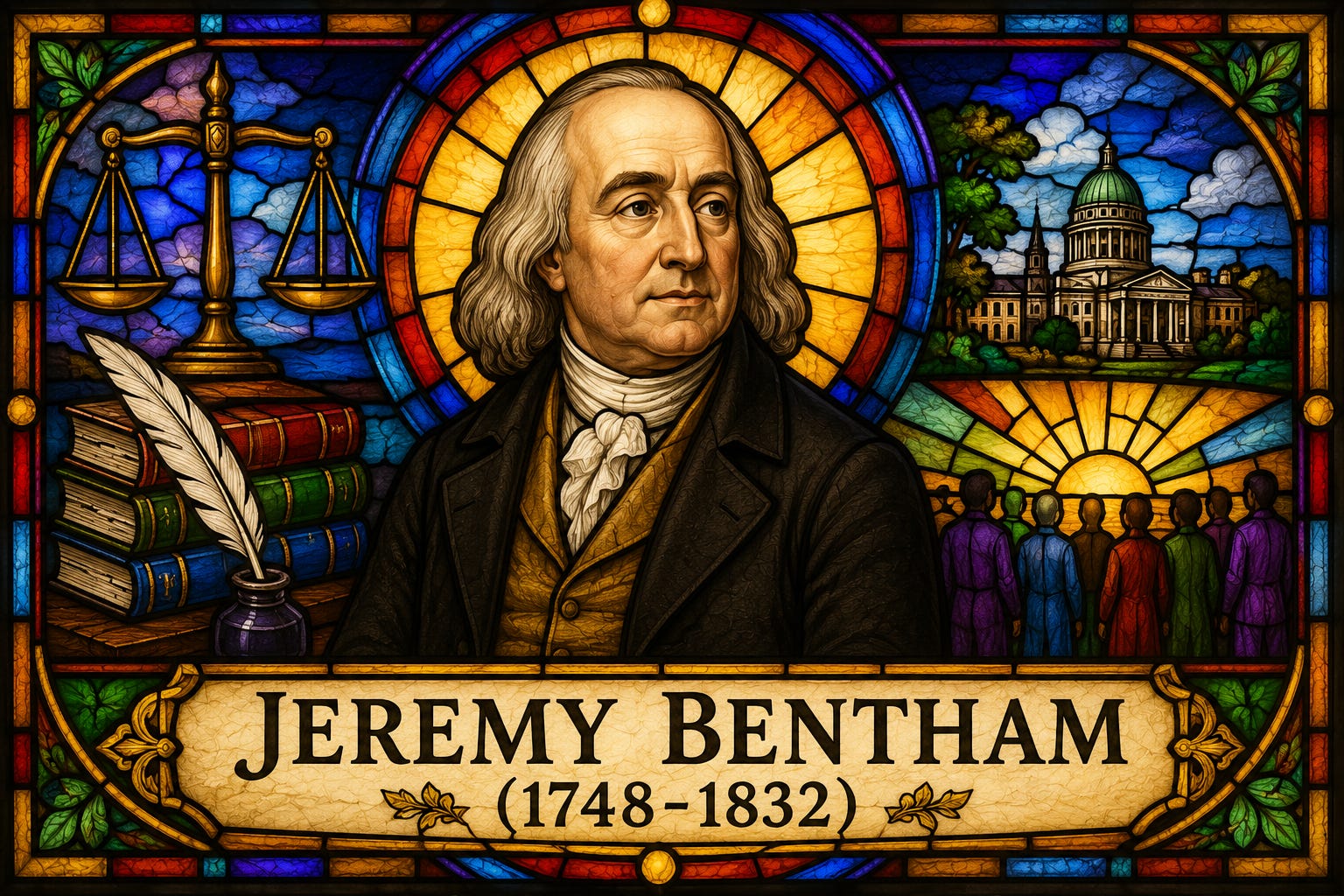
That is the word on my mind as I drive amid the cornfields of Ohio and reflect on the life of Jeremy Bentham, the English philosopher and reformer whom we remember today.
The Man Who Questioned the Unquestionable
Jeremy Bentham (1748-1832) lived in a world full of unquestioned assumptions.
The Church held enormous influence over public life. Women possessed few rights. Homosexual acts were punishable by death. Divorce remained largely inaccessible. Religious dissent invited suspicion. Social hierarchies were regarded as natural and permanent.
And in this context, Bentham asked a dangerous question:
What if many of our assumptions are wrong?
He proposed a startlingly simple principle. The purpose of laws and social institutions should not be to preserve ancient customs. The purpose should be to promote—wait for it—human flourishing!
His simple axiom: “The greatest happiness of the greatest number is the measure of right and wrong.”
While the phrase can oversimplify the complexities of ethics, Bentham’s larger insight remains powerful: We must constantly evaluate whether our laws, customs and institutions are actually helping people and bringing greater happiness to the world!
That question remains every bit as relevant today as it was two centuries ago.
Jesus and the Breaking of Taboos
One reason I find Bentham so intriguing is that his willingness to challenge taboos reminds me of Jesus.
No, Jesus was not a Benthamite or utilitarian philosopher, but he repeatedly demonstrated a remarkable indifference toward social and religious taboos whenever those taboos harmed people.
Religious authorities obsessed over handwashing rituals. Jesus focused on the condition of the heart (Mk. 7:1-23).
Religious authorities condemned healing on the Sabbath. Jesus healed anyway (Lk. 13:10-17).
Religious authorities avoided Samaritans. Jesus made a Samaritan the hero of one of his most famous parables (Lk. 10:25-37).
Religious authorities condemned women with questionable reputations. Jesus welcomed them into his circle (Lk. 7:36-50).
Religious authorities guarded purity boundaries. Jesus touched lepers, dined with tax collectors, and embraced the excluded (Mt. 8:1-4; Lk. 5:27-32).
Concerning the taboos that were considered “sinful” in his day, Jesus seemed to say: You are obsessing over the wrong things. Eat that pork chop or that catfish (Lev. 11:7-12). Wear that cotton-poly blend (Lev. 19:19). Go ahead and play football (Lev. 11:7-8). But for God’s sake, love God and love others (Mt. 22:36-40)!”
Perhaps that is why Paul would later write: “For freedom Christ has set us free” (Gal. 5:1).
Not freedom to exploit others. Not freedom to harm. But freedom to love and to bring greater happiness to this world!
The Wisdom of Separation
Among Bentham’s most enduring contributions was his advocacy for the separation of church and state.
History demonstrates why this matters.
When Constantine merged Christianity with imperial power in the fourth century, the Church gained influence but lost something precious: The faith rooted in the teachings of a crucified carpenter increasingly became entangled with the ambitions of emperors!
The result was not always holy. Think Crusades, the Inquisition, religious wars, and colonialism.
Sadly, the temptation to use God as a mascot for political power has never disappeared. We continue to witness it today.
I suspect many Americans will never forget the image of protestors being forcibly removed from Lafayette Square after the 2020 murder of George Floyd so that a president could stage a photo opportunity holding a Bible (upside-down, remember?) in front of—wait for it—a church.
The image was powerful. It was also profoundly unsettling. Almost as unsettling as seeing the same president stage another photo op, only 90 days ago, with 20 evangelical faith leaders praying over him in the Oval Office and blessing him after he bombed Iran.
Jesus wept.
You simply cannot reconcile the Jesus who taught us to love enemies, welcome strangers, and bless peacemakers with such political spectacles designed to project dominance and power.
The line between faith and nationalism is often thinner than we realize. And when that line disappears altogether, both democracy and religion suffer.
Divorce, Annulments and Human Complexity
Bentham also argued for the right to separation and divorce—and few issues reveal our discomfort with changing realities more than divorce.
One of the most discomforting aspects of my 25 years as a priest involved the Roman Catholic Church’s annulment process.
A person could be divorced for years, remarried, with children born of love, and with a life rebuilt. Yet they could not receive Communion or serve as a godparent because the Church insisted that their previous marriage still existed. I couldn’t make that up.
Thus, the annulment process. With its 27 pages of paperwork. With intensely personal questions about sexual history and psychological health. And the testimony of witnesses. All in an attempt to craft canonical arguments to demonstrate that a marriage that clearly existed somehow never truly existed. It was truly confounding.
I remember the wounded people sitting in front of me wondering why they had to revisit old pain. I wondered the same. We must ask: What would Jesus do? The Jesus who repeatedly placed human beings before institutions? The Jesus who reminded us that “the Sabbath was made for humankind, and not humankind for the Sabbath” (Mk. 2:27)?
He would no doubt encourage mercy over bureaucracy, healing over gatekeeping, and compassion over control!
Women, Equality and the Long Arc of Justice
Bentham also advocated for equal rights for women, a position considered extremely radical two centuries ago.
But let this sink in: The United States will soon celebrate its 250th birthday. Yet American women gained the right to vote only in 1920. For 144 years after declaring our independence—for over half our history—half our population was excluded from the ballot box! Even now, more than a century later, U.S. women are paid 81 cents on the dollar for the same work performed by men. Let’s call this what it is: a social sin. An injustice. A crime against our sisters, mothers, grandmothers, daughters and granddaughters.
The scriptures themselves have often been used to justify women’s exclusion. Certain passages have been elevated, while others have been ignored.
Meanwhile, Jesus consistently elevated women.
Mary of Bethany sat at his feet as a disciple (Lk. 10:38-42).
Women accompanied him throughout his ministry (Lk. 8:1-3).
Women became the first witnesses to his resurrection (Jn. 20:11-18).
At crucial moments, women often demonstrated greater courage and fidelity than the cowardly men who ran away!
2,000 years later, the struggle for equality remains unfinished. Our daughters today possess less freedom and bodily autonomy than their mothers and grandmothers. And twice now we have chosen to elect a man described by The Huffington Post as “a serial liar, rampant xenophobe, racist, misogynist, birther and bully,” rather than enjoy the wisdom of a woman in the highest office in our land. Twice.
It makes no sense—until you consider that our Grifter-in-Chief is simply a symptom of the deeply racist and misogynistic sycophants who surround him and citizens who support him.
The scriptures repeatedly challenge us to resist such evil, and to advance the freedom and dignity of all God’s children—regardless of the bodies into which they were born!
Bentham, Homosexuality and the Courage to See
Perhaps no Bentham taboo speaks more directly to me than his defense of our LGBTQIA+ siblings, children and grandchildren.
In Bentham’s England, men could be hanged for same-sex intimacy. Imagine living with that fear. Imagine knowing that who you loved could cost you your life!
Bentham quietly argued that such laws were unjust, and his essays defending the decriminalization of homosexuality remained unpublished during his lifetime because the consequences were simply too dangerous.
Two centuries later, my husband and I stood on the lawn of the Texas State Capitol and exchanged wedding vows. The slogan of that moment in U.S. history was simple: Love is love.
Jesus would have understood this. And blessed it.
The Christian scriptures repeatedly emphasize the quality of love, rather than the gender of the people involved. The “fruits” matter. The love matters. The fidelity matters. The kindness matters. The commitment matters.
If marriage exists solely for procreation—the traditional “natural law” argument in the Roman Catholic Church—then there would be little reason for elderly couples to marry beyond childbearing years. Yet no sensible Christian would make such an argument.
Marriage is about far more than reproduction. It is about companionship. Mutual support. Commitment. Love.
Those truths apply broadly, and Bentham recognized something that many still struggle to see: Criminalizing love harms people. It creates suffering. It diminishes happiness. It denies dignity.
Opening Our Eyes
After arriving in Ohio on Thursday, I spoke with a local resident who complained about soaring gas prices. I responded, rather tersely: “I didn’t vote for him.” The man immediately knew whom I meant, and he nervously laughed. Then he admitted, almost in shame: “I did.”
There was something fascinating in that moment.
Not anger. Not hostility. Just a brief moment of reflection. A moment of possibility, for the opening of one’s eyes. It was as if, for a moment, he questioned the unquestionable.
Bentham spent his life encouraging people to question their beliefs and assumptions. Jesus did much the same. Both understood that growth begins when we become willing to ask difficult questions.
The problem with taboos is not merely that they silence conversations. The problem is that they prevent learning. They prevent empathy. They prevent transformation.
And transformation is precisely what faith is supposed to accomplish!
Seven Ways to Challenge Harmful Taboos
Create spaces where difficult conversations can occur without fear or condemnation.
Advocate for the separation of church and state whenever either institution attempts to dominate the other.
Support policies that advance the dignity and equality of women.
Fully welcome LGBTQIA+ persons in every aspect of life.
Prioritize love, compassion and healing, over legalism and bureaucracy.
Study scripture with fresh eyes, asking whether inherited interpretations still reflect the spirit of Jesus.
Practice extraordinary curiosity when encountering beliefs different from your own.
From Whispered Secrets to Extraordinary Freedom
As I sit once again among the cornfields of rural Ohio, I find myself remembering all those whispered conversations from my youth. The scandalous pregnancies. The divorces. The rumors. The things people were not supposed to discuss in polite conversations.
Some taboos protected people. Many simply protected power.
Jeremy Bentham understood the difference. So did Jesus.
Both challenged us to look beyond inherited assumptions and ask deeper questions:
Does this help people flourish?
Does it bring healing?
Does it foster love?
Does it create greater freedom?
Does it bring greater happiness to this world?
As we move through this very unordinary U.S. moment, perhaps we need fewer whispered judgments and more courageous conversations. Perhaps we need fewer “sacred cows” and more sacred curiosity.
And perhaps the path toward God’s reign begins when we finally stop fearing the questions that might actually set us free!
Questions for Prayer and Reflection
What taboos from my upbringing continue to shape my thinking today?
Which of Jesus’ actions most challenged the social norms of his own time?
When have I changed my mind about an issue after listening to another person’s perspective or experience?
Do I place greater emphasis on rules or on relationships?
How might I better defend the dignity of those whom society marginalizes?
What assumptions about faith, politics or morality deserve fresh examination?
Where is God inviting me toward greater freedom?
Let Us Pray
God of truth and freedom,
You created us not to live in fear, but to live in love.
Give us the courage to examine the assumptions we inherit, and the humility to admit when we are wrong.
Help us to distinguish between traditions that give life, and traditions that cause harm.
May we follow the example of Jesus, who consistently placed people before rules, compassion before condemnation, and love before fear.
Grant us extraordinary wisdom, extraordinary courage, and extraordinary compassion in this very unordinary U.S. moment.
And may we always seek not merely what is familiar, but what is just, what is merciful, and what is true.
Amen.
We thank you for your prayerful consideration of a personally-meaningful gift to support progressive Catholic voices. According to the Pew Research Center, 47% of Americans have a personal connection to Catholicism, and 13% of U.S. adults self-identify as former Catholics. Help us reach them with real good news!
Thank you for “liking,” restacking or sharing these words with those who might need them now!
Reach out to us! editor@extraordinarycatholics.faith | P.O. Box 2386, Austin, Texas 78768
“There was something fascinating in that moment.”
That magic moment. Thank you. I enjoy these Substack reflections.
Jeremy Bentham and Jesus. Who woulda thunk.